

There's no single age that's right for every child, but most kids are able to fall asleep alone by kindergarten, and independent sleep is fairly well established for most by around age 6 or 7.
If your child is older than that and still can't settle without you in the room, it's worth understanding if there is an underlying cause to their trouble sleeping and how to support them.
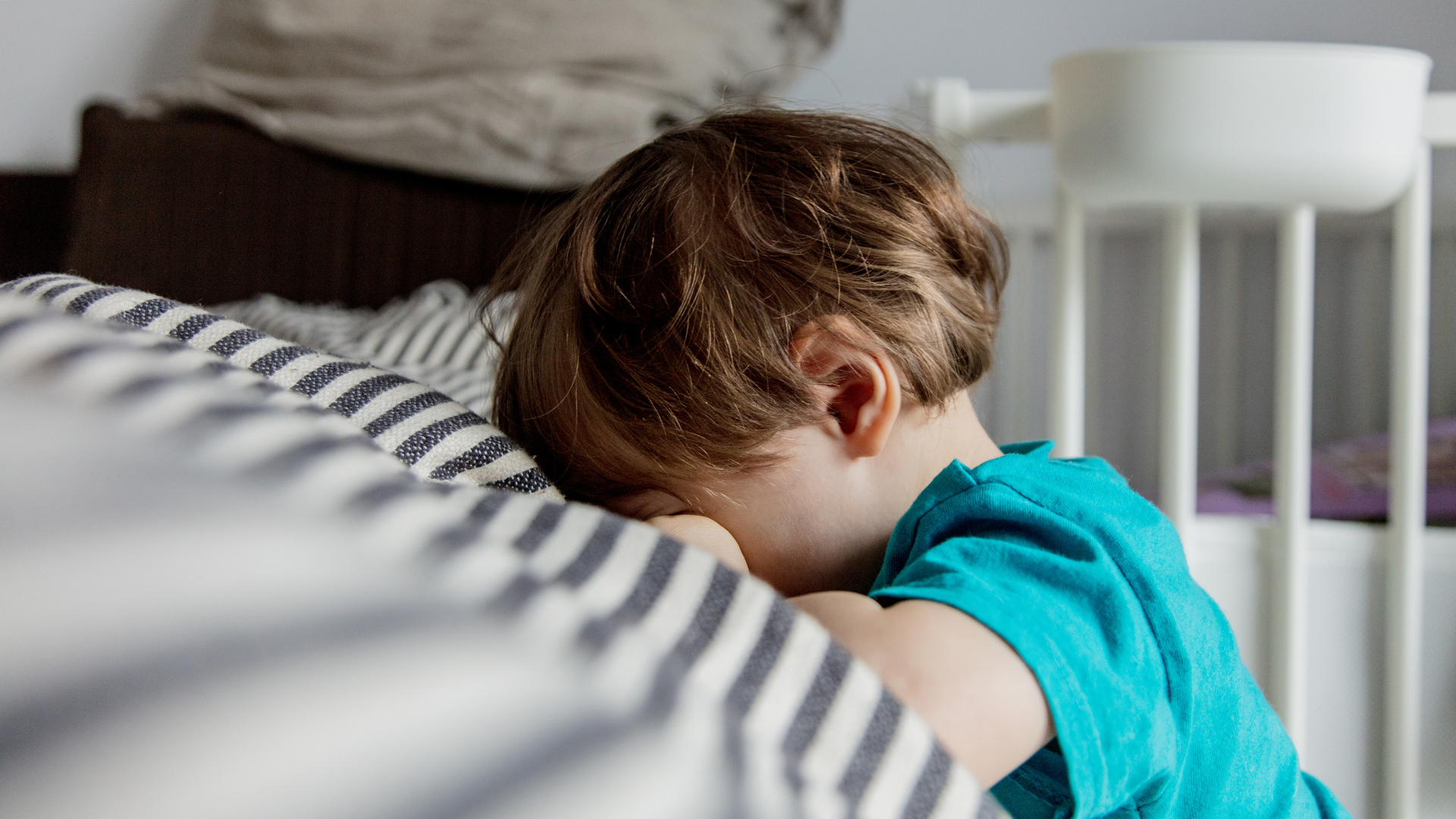
Is It Normal for an Older Child to Still Need Help Falling Asleep?
Short answer: often, yes, at least at first. Falling asleep alone is a learned skill, not something children arrive with automatically, and kids build it on different timelines.
A rough developmental map may look like this:
Toddlers (2-3): Needing a parent nearby at bedtime is expected. Object permanence and separation fears are still developing at this age.
Preschool (3-5): A great window to start building independent sleep skills, since kids this age can follow simple routines and understand cause and effect well enough to stick with a plan. Many pediatric sleep experts consider this a great age to help kids fall asleep alone.
Early elementary (5-7): Most children can fall asleep alone and stay in their own bed through the night, though occasional check-ins during stressful stretches (a new school year, a move, a sick pet) are common and not a red flag on their own. If your child is having trouble falling asleep at this age, it’s worth looking further into.
Age 8 and up: Persistent difficulty sleeping alone at this age is worth a closer look, not because something is "wrong," but because it's usually a sign an underlying worry hasn't been addressed yet.
Sleep researchers and pediatric guidance generally point to somewhere in this range, though family culture, household setup, and a child's temperament all shift where the line falls for any individual kid.
Age-Appropriate Clinginess vs. Separation Anxiety: What's the Difference?
Age alone doesn't tell the whole story. Two eight-year-olds who both climb into their parents' bed at midnight can be dealing with completely different things.
For one child, it might be a habit. The pattern started during a rough stretch (illness, a new sibling, a move) and just never got reset once things calmed down.
For another, it's separation anxiety: a persistent, disproportionate fear of being apart from a parent that shows up at night and often in other settings too.
Signs that your child’s sleep struggle is tied to separation anxiety rather than habit alone may include:
Specific fears about safety, like something happening to a parent or someone breaking into the house. These fears often come up in kids even if there is no history of attempted break-ins.
Trouble separating in other contexts, not just at night, such as school drop-off, sleepovers, or day camps.
Physical complaints (stomachaches, headaches) that show up mainly around separation. Your child may genuinely think or feel that they are sick during these times as anxiety can cause physical symptoms
A child who can't quite name "anxiety" but is adamant about needing a parent nearby during sleep or periods of separation.
This distinction matters because habit-driven sleep issues usually respond quickly to a consistent routine, while anxiety-driven ones need that routine plus direct support for the underlying worry.
Child Mind Institute's guidance on this overlap is worth a read if you're trying to sort out which one you're seeing.
Why Separation Anxiety Shows Up at Night
Nighttime strips away the distractions that usually keep worry in the background. No homework, no screens, no siblings to argue with, just a quiet room and a child's own thoughts.
For a child prone to worry, that quiet is exactly when fears about safety or being apart from a parent get loudest.
One pattern we watch for in session: we'll ask a child what specifically goes through their mind once the lights are off, and most kids who are managing genuine separation anxiety can name something concrete,
a parent getting hurt,
the house catching fire,
being unable to reach you if something happened.
Kids who are dealing with plain old habit or stalling usually can't point to anything specific; they just don't want bedtime to be over.
What Helps Kids Sleep in Their Bed
A few strategies work well whether you're dealing with a lingering habit or genuine anxiety:
Keep the routine similar every night. Predictability itself is calming, and it removes the negotiation that habit-driven stalling depends on. For kids with anxiety, a consistent and predictable routine also helps ease their bedtime worries.
Move the goodbye earlier, not later. A drawn-out bedtime, with parents lingering "just a bit longer," tends to reinforce the exact dependence you're trying to loosen.
Normalize the fear without over-explaining it. A brief, matter-of-fact response works better than a long conversation about why there's nothing to be scared of.
When To See a Therapist if Child Isn’t Sleeping Alone
If your child is well past the age where independent sleep is typical, and a consistent routine for several weeks hasn't moved the needle, or the worry is clearly bigger than bedtime, that's a reasonable point to bring in support.
We often use Cognitive Behavioral Therapy (CBT) to help kids build tolerance for the discomfort of being apart from a parent, and SPACE (Supporting Parents for Anxious Childhood Emotions), which works with parents directly to adjust the accommodations that unintentionally keep the anxiety going.
Both are designed to help a child face something hard but ultimately safe, whether that's an empty bedroom, a sleepover, or a parent leaving the room. Our child anxiety therapy services in San Diego are built around exactly this kind of plan.
FAQs About the Right Age for Kids to Sleep Alone
Is it a problem if my 8-year-old still can't sleep alone?
Not automatically, but it's worth a closer look. Most kids that age have the skill in place, so persistent difficulty usually points to an underlying worry rather than a developmental stage.
How long should we give a new bedtime routine before considering therapy?
Give a consistent approach two to four weeks. If there's no meaningful movement, or the anxiety is showing up in other areas of your child's life, that's a good signal to bring in professional support.
Get Support From a San Diego Child Therapist
If you're not sure whether what you're seeing is a passing stage or something that needs more attention, that uncertainty is exactly what we help parents sort through every week.
As a San Diego child therapist team with roots here in La Jolla, we work with families across the region on exactly this question.
Reach out to schedule a consultation. We offer in-person appointments in La Jolla and telehealth throughout California, and we're glad to help you figure out what's behind your child's sleep struggles and build a plan that fits your family.
Child Therapy for Anxiety
No parent wants to see their child held back by fear or constant worry. At SoCal Child Psychology in La Jolla, we offer child therapy for anxiety that helps kids across San Diego feel safer, calmer, and more confident.
Through play-based strategies and proven therapies, we teach children practical coping skills they can use at school, at home, and with friends.
Parents are also included in the process, so you’ll have tools to support your child along the way.
Contact us today to learn more about anxiety therapy for children in San Diego and how it can bring peace back to your family.